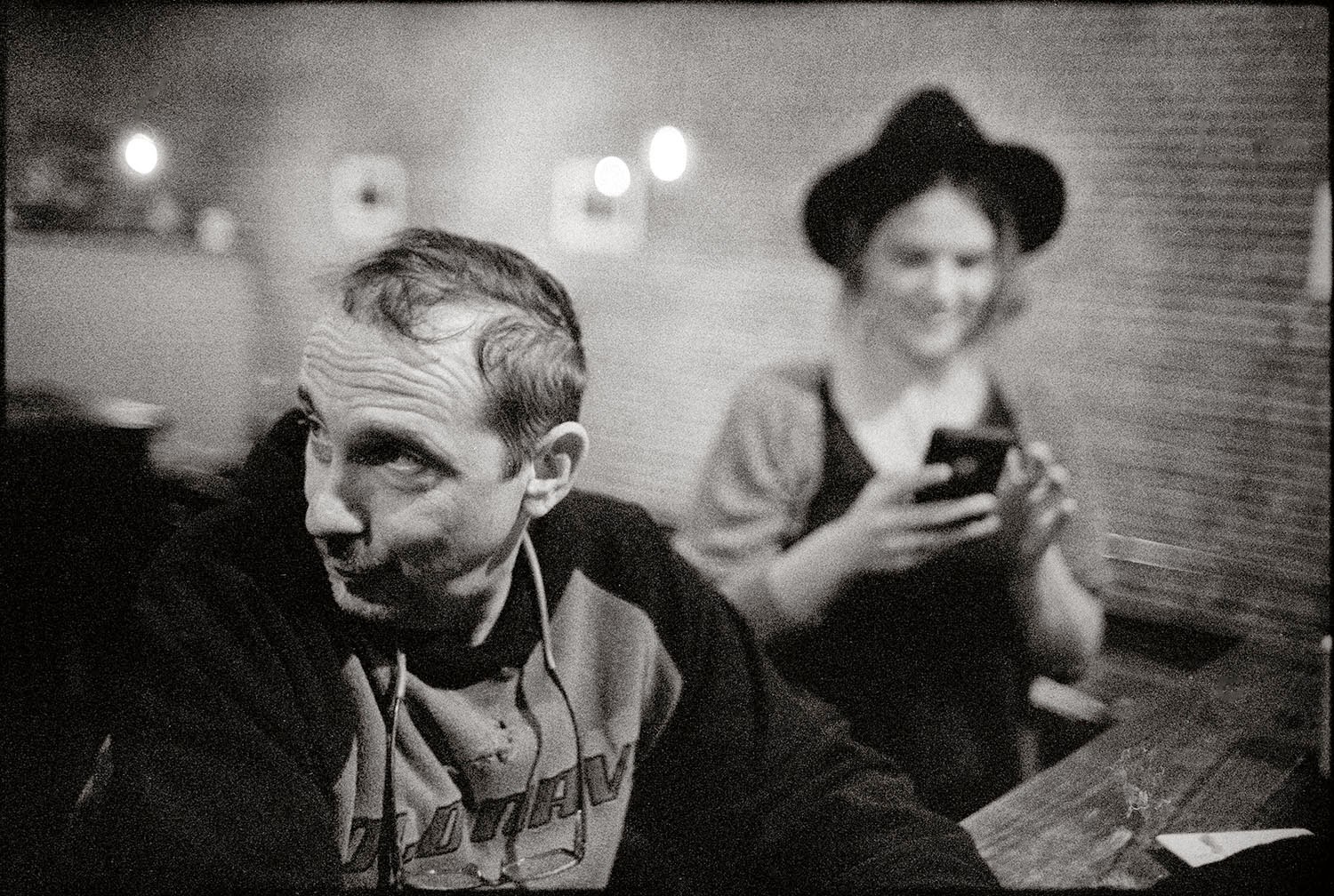
Over a month ago I shot some film at a small art show by some friends of mine at their house. There was a bonfire and live music. Here's a few images using one of the last rolls of my precious Kodak Elite Chrome 400:
One of the pieces you can see hanging in the background in two of the photos above I bought. It's now on my mantle in my office!
Sunday, December 21, 2014
Saturday, December 20, 2014
Photography @ Grassroots, Downtown Valdosta
My friend Tara was exhibiting some photographs last night so I went to her opening. Meagan and I also traipsed around downtown at night and in the drizzling rain. I wanted to try out an MD2/MB1 motor drive for my F2, to make sure everything worked fine for my holiday trip. There will apparently be plenty of rain this Christmas in New Orleans / Biloxi so I will bring a rugged 35mm SLR instead of my Leica M6 or Nikon SP.
The motor drive worked fine but the power rewind seems to hang up. I think there may be a gear stripped, but I've read that it's fixable with newly manufactured parts. I rewound the film and thought it was done but as you'll see in one photo, opening up the back I saw the film wasn't finished rewinding. Oops! Of course I can manually rewind anyway.
Anyway, here's some photos, shot on T-Max 3200 rated at around 400-800 and developed in Acufine for 8 minutes at 62 degrees or so (my shed gets cold in the winter, no heat!):
Saturday, December 13, 2014
More 35mm Panoramas, with Agfa Optima 100
Just wanted to post a couple color images from last week. Winter has set in and it's been very cold. I feel like these images captured that coldness a bit.
Taken with some old bulk-load Agfa Optima 100 film in my 6x12 back, with either a Nikkor 90mm f/8 or Schneider 58mm f/5.6 XL:
Monday, December 8, 2014
Tri-Color Photographs
Late last year I did some experiments and made a really cool image using the "tri-color" process by which you shoot 3 black and white images with color separation filters (25, 58, and 47), and then combining them to make a "color" image. This is an old technique that was pioneered most famously perhaps by Sergey Prokudin-Gorsky in Russia in the early 20th century.
Anyway, now with digital technology and scanning, this process is even easier. Well, relatively. It's hard to get all the exposures right depending on the filter factor, spectral response of the film, reciprocity, etc. I am still working on it. It's easier on roll film since you can shoot several "groups" of shots, and even bracket, on one roll of film, but I'm trying to do it on 4x5 film.
What I've been trying to do is combine this technique with long exposures to capture motion in a novel way. Amazingly, my first try created a pretty stunning image:
This was back over a year ago but for some reason I never put it up here on the blog.
Since then though I've been trying to do something similar, without much luck. I was lucky last time. The way this works is to find a good time where leaves or whatever are floating down the river at a moderate speed. The exposures above were in the neighborhood of 15-30 seconds if I remember right.
A few weeks ago I had a good opportunity to try this but didn't bring my color filters. Today I tried again, but there just wasn't enough material in the water to show the color streaks, not to mention some weird fogging on the green sheet:
Also the overcast, low-contrast day might not have been the best.
I've found that generally, the corrections for the filters for T-Max 100 are:
Red 25: 2.5 stops
Green 58: 2 stops
Blue 47: 3 stops
I'll keep trying!
Thursday, December 4, 2014
Waycross Thanksgiving 2014
Here's the group shot on Delta 100, developed in FX-39 1:19 for 8.5 minutes. You can see me holding the bulb to trip the shutter.
I also had a sheet left over of CDU II film from some experimenting I was doing, so I tried it out here. CDU II is a duplicating film and is a tungsten E-6 film. So I put an 85B filter on it and shot it at ISO 3. Which is really slow! So I ended up using the lens at f/4.7 and 1/30 exposure I think it was:
Not bad, and my first E-6 8x10 development success! I have to do each sheet by hand in a rotary tube, in a water bath. It's tiresome (about 30 minutes each sheet for the whole process) but wow, 8x10 positive film!
I also brought my Fujica 690 along for some casual snapshots:
As I mentioned, I was experimenting with that CDU II film. Here was my first test, for posterity. It was too late in the evening so the blue light was too much for the tungsten film, even with an 85B filter, so I definitely in the future will be using it in nice warm sunlight:
Subscribe to:
Posts (Atom)
.jpg)
.jpg)
.jpg)
.jpg)
.jpg)
.jpg)
.jpg)