Showing posts with label Kowa 210mm. Show all posts

Monday, March 28, 2016

Wehman "Ultralight" 8x10 Field Camera

These days it seems like there is no shortage of new companies building 8x10 and other size field cameras, often with space-age materials and impressive specs (and impressive price). I bought my first 8x10 camera, a Gundlach built in 1899, about 4 years ago. It was cheap and came with a cool lens, and I shot nothing but x-ray film with it for a long time. Later on I found a Wista 8x10, made by Tachihara, that was a bit more versatile and easier to use - but it was still really heavy and the thin paper bellows made me worried when hiking, as an errant tree branch could puncture it and ruin the camera.

I started thinking about upgrading my camera but the expensive new production models, even used, were just not the right fit for me. They were also for the most part still quite heavy. So when I saw a Wehman 8x10 "ultralight" advertised, I was intrigued. Looking up the specs, I discovered it was about 7 pounds, plus another pound could be shaved off by removing the top "clamshell," reducing the total extension (which I rarely would use). My mind was made up. I bought it.

In-hand, I was really amazed by the simple and elegant design and the great look of the camera. In the field, it was the perfect blend of simple usage and versatility. I have read in several places that Wehman only made two of these "ultralight" models but I can not verify that. Either way, I think this is the last 8x10 camera I'll ever need.

Last weekend I took it for its first large hike (about 3 miles). It was easy to carry and didn't weigh me down, and being so light I could also use a slightly less heavy tripod without worry. I hardly broke a sweat carrying the load, with 4 lenses in my bag and 12 sheets of film in 6 holders.

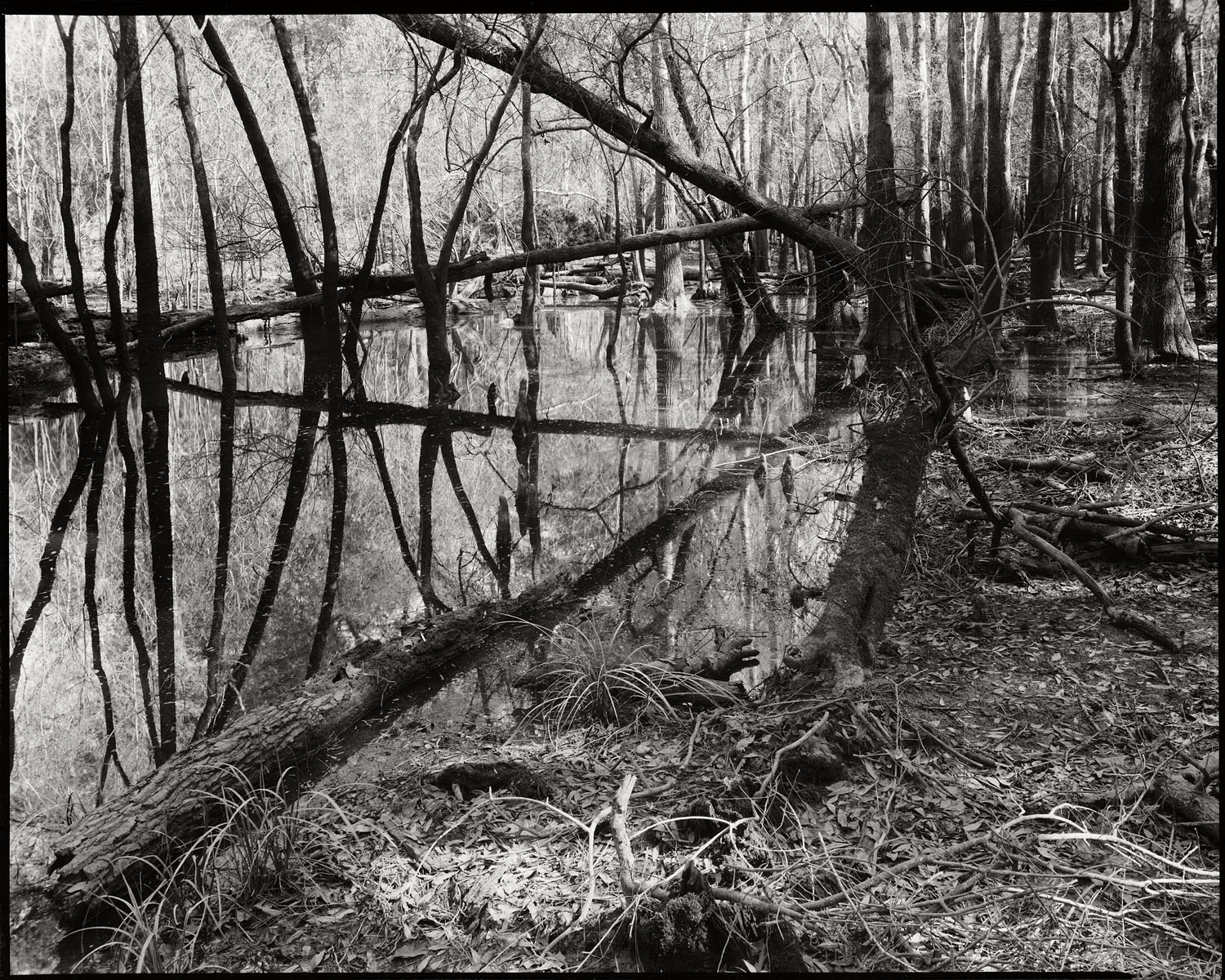
I hiked at Langdale Park, which was closed for "repair" earlier this year - but a local conservation group was allowed access to paddle down the river and take out at Langdale Park, so I tagged along.

Here are the photos from that day. First are a few on Delta 100, developed in FX-39, using either my 210mm f/9 Graphic Kowa, 300mm f/9 Nikkor-M, 25cm f/4.7 Fujinar, or 90mm f/5.6 Schneider XL (cropped slightly):


I also tried out two photos on Efke IR820 AURA film. I have a big box of this I've never used. Here are those photos (duplicates of the above, as I wasn't sure the Wehman bellows were IR light-tight...luckily it is!):


Finally, I had one more sheet of Delta 100, so I took this photo of the WWALS group with that:


Now right before I took this last image, I had one bad thing happen - I slipped and fell pretty bad on some mud. The Wehman 8x10 took a dive and hit the ground hard too. Everything seemed okay, but then I discovered the nylon focus track had a few teeth go missing! I was dismayed, but I sent Mr. Wehman an email to see if he had parts. Amazingly, he responded later that day and offered to send a free replacement! What a great service and awesome guy! I just received the part today and installed it in just a few moments, and it's back to like-new condition (after I cleaned up the mud...).

I love this camera and can't wait to shoot it more!

Oh! One more thing. My friend Julie took this photo of me with the camera before I left:


Monday, February 8, 2016

Fast flooding of the Withlacoochee, Feb. 2016

I didn't think we had much rain last week, but nevertheless the Withlacoochee is way outside its banks and over 5 feet above flood stage. Yet again Valdosta is causing grief for Florida as the sewage treatment plant is discharging untreated water into the Withlacoochee.

I went to Langdale Park but the water from the river was all the way up near the entrance, barely a few hundred yards from the gate. Even with my wading boots I couldn't go far. I found a little side area I could explore and shot some with my new 8x10 camera (more about that at a later time).

I also decided to shoot a bit of x-ray film, as I hadn't shot it in quite a while. However, I had one extant sheet of Delta 100 from the last outing so I did a comparison shot. Very interesting result.

Here is my favorite shot of the day, on x-ray film:


This was shot with my 90mm XL on 8x10, but yes it had trouble covering. Actually, now that I think about it, I left the back barrel piece that can be removed on it so I might get a bit more coverage without that. Anyway, this crop is about 8.5 x 6.8 inches. I shot the Fuji HR-T film at an ISO of 100 and developed it in Rodinal 1:100 for about 7 minutes in cold solution (my darkroom has no heat and is very cold at the moment). Overall I really like the results.

The Delta 100 shot was an interesting comparison. Over all the contrast was higher, and I lost the shadows and highlights. This was partially my fault in developing. I was using a developer and time/dilution that was more appropriate for normal developing rather than rotary (I used a BTZS tube). So not the best test, but certainly interesting. Here that shot is:


One of the things about x-ray film that is different than normal film is the lack of a anti-halation layer. This causes slightly glowy highlights and slightly less resolution. Here is a small crop of x-ray film and the Delta 100 to show the differences:


There are some x-ray films that are more expensive that do have the AH layer. I use Fuji HR-T because it is really cheap. Generally it's not a big deal but still, if I'm especially worried about it I'll use normal film - though again, as you can see above, the contrast in this situation was better handled by the x-ray film, and more specifically, how I developed it. The most important thing here is to know your tools and materials, I suppose.

Here's a couple other photos from yesterday, all on the x-ray film - the first with my 210mm Graphic Kowa, the second with the 90mm XL again:


Tuesday, April 7, 2015

Shooting 8x10 for Van Dyke Brown Negatives, Part 1

I have on and off again experimented with alternative photographic processes, without a lot of success. I either didn't have the right negative density, or the UV exposure from the sun wasn't right, etc. However recently I found out we have a nice UV exposure unit for printmaking at the university I work for that I can use, which means I could eliminate some variables and hopefully make some decent prints.

In an effort to make good negatives first, I shot some this past weekend with my 8x10 and experimented with pyro developer. Staining developers such as Pyrocat are overwhelmingly suggested for alt processes due to their unique properties. I've given up Pyrocat as unreliable for my own uses years ago but I had been using Tanol recently, mostly out of curiosity and since it was relatively cheap.

I couldn't find any good film development recipes so I just experimented with 8 negatives to find the best development time and dilution, which I will document here.

I shot 8 negatives of ERA film, which from what I understand is either rebadged Ilford FP4+ or so close as to be indistinguishable. I shot it at an ISO of 64. I developed the negatives in Tanol diluted 2:2:100, which is a double-strength dilution, mostly in an effort to keep the development times down. I developed 2 negatives at a time in BTZS rotary tubes for 8 minutes, then 10 minutes, and finally 12 minutes. The 12 minute negatives were the most dense and looked good for typical printing. The 12 minute negatives looked nice for the needs of alt processes.

Pyro-developed negatives supposedly are good for making images that can be printed with various alt processes as well as typical silver printing and scanning. All of my negatives did indeed scan well, even one that was overexposed a little bit. The best negative I measured on a densitometer and the UV setting showed a density range of about 0.5 to 2.2, which I believe is just right for Van Dyke Browns.

I coated some paper and tried some test prints on the UV exposure unit and dialed in an exposure. Tomorrow I am printing a couple more that should be just right!

For now, here are some scans of the negatives (one was cropped slightly). All were either shot with my 210mm f/9 Graphic Kowa or Nikkor 120mm f/8:


Sunday, July 28, 2013

Some new 8x10 photos with Wista (Tachihara) camera

I went for almost 10 months without touching my 8x10 camera. The reason? I never quite got along with my Kodak Century Universal. Sometimes I just don't click with a camera. When I really enjoy a camera, I always get better images because I am more at ease using it. For example, I owned a Hasselblad 500c/m for about a month before reselling it because I really did not like it. To each his own.

Anyway, I am rekindling my interest in 8x10 as I picked up a Wista 8x10 field camera (made by Tachihara) on a lark. I really like this camera - it is much more intuitive for me than the Kodak. It also has better movement control, though it unfortunately does not have any shift, which is slightly disappointing (though you can "force" it to shift slightly by using both front and rear swing).

It also came with a Technika adapter, so it works right out of the box with all my lens boards.

Anyway, I shot a few sheets of my typical Fuji HR-T x-ray film to test out the camera and try developing with Pyrocat HD. Here's a few images:


Tuesday, November 13, 2012

Re-evaluating 8x10 x-ray film

I've started working with the 8x10 x-ray film again. I have had plenty of good shots from it, but I still am stymied at times with high-contrast scenes, especially those with sky in it. I shot four sheets out at Langdale Park as an experiment. I developed them in Rodinal 1:100 for 7:30 at 68F, and I rated the film at ISO 50. The negatives look good, but as you'll see the sky in one photo is totally gone, and causes issues with the tree tops. So I think I need to try cutting the development in a scene like that drastically, to like 6 minutes. Perhaps I will man up and just shoot a half-dozen sheets of a scene with sky and see what I can do.

Anyway, here are the photos. Lenses included the Graphic Kowa 210mm, Nikkor 450mm, Gundlach Radar 300mm, and Nikkor 120mm:


Tuesday, September 18, 2012

Short trip to Reed Bingham with 4x5

I took some shots out at Reed Bingham last week but only finally tonight got around to developing them.

I'm having some trouble getting consistent 4x5 results because of problems with my plumbing here. I don't have running water in the darkroom right now, plus the water that I am bringing in from a spigot is too hot.

Only a couple of these sheets came out that great due to these problems but I'm still okay with that, as at least the palmetto photo came out really nice.

I used T-Max 100 and Rodinal 1:50 for these. Lenses used are as noted.

210mm Graphic Kowa:


Nikkor-T 500mm:


Nikkor-M 300mm:


Thursday, September 6, 2012

Sunset Cemetery at Sunset - 6x12 panoramic images

I'm a little behind in posting things so I'm going to try to post several things by the end of the week.

I just got a Horseman 6x12 back to replace the 6x17 that I had. It was frustrating to use because it was an expansion back, meaning I had to frame the image on a separate ground-glass assembly, then switch in the actual roll-film holder, and finally shoot. The worst part about this was that I could not use any lenses that were shorter than 90mm (a ~75mm might have worked, but I don't own one). Plus, anything longer than 90mm started to clip on the sides and not really be 6x17. A 210mm was already clipped to a 6x12 instead.

The 6x12 back instead requires you to focus on the normal GG, and then you put the back on. It works really nicely and it is really easy to use on the Chamonix 4x5 because it already has frame lines for 6x12 images (as well as 6x7 and 6x9).

Here's three images from Valdosta's historic Sunset Cemetery, appropriately taken as the sun was setting soon after a storm cleared. I am most pleased with the first one, though I wish there was more shadow detail. I'm going back today at the same time to retry it with a different film. I was actually leaving as I came upon that wonderful scene, so I had nothing but some cheap Arista EDU 100 film that I've never shot before. Today I'm bringing some Ilford FP4+ which I've used before, or I might shoot it with Tri-X 400.

The other images were with some HP5+ I had sitting around. I'm trying to shoot a bunch of 120 film that I was given and haven't had the chance to shoot. The roll-film back is especially nice for this.

The first two were with the Nikon 90mm f/8 lens, and the last was with a 210mm f/9 Graphic Kowa:


Stay tuned for some interesting posts in the next couple of days!

Thursday, June 21, 2012

Withlacoochee Project, Part 4

I've been a terrible blogger lately. I had an unscheduled trip though that took me out of town unexpectedly and then got sick, but finally I got to shoot some today. Here are two snaps of contact prints from 8x10 x-ray film - my scanner is currently disconnected so that's all I have. These were taken along what I believe is a tributary of the Withlacoochee, so I'm including it with the other project shots.

Both were taken with a 210mm Graphic Kowa at f/32. I added a little warm toning with my computer:


Saturday, May 26, 2012

Providence Canyon, 8x10 style

Yes, I'm still alive, if anyone was wondering!

I've been swamped with "real life" lately, working on a great number of projects, both personal and professional, as well as starting up my summer job that I have done every summer for 8 years now (working at an instrument repair shop.

Anyway, as I mentioned last post, all last week I was out of town in various locations. My first stop was Providence Canyon. I decided to lug my 8x10 all over this canyon system because I wanted to try a new lens primarily, but also because I'm crazy. My load was somewhere in the neighborhood of 60 pounds or more.

Well all that and I only took two shots. But they came out really well. When I get a chance I'll be contact printing both of these. So I also took my nice shiny new D800E as well. I didn't really take a single outstanding shot on the D800E. As much as I try, I just can't quite gel with digital shooting landscapes. I think the tactile experience of shooting a large format camera, along with the act of composing the image on a huge piece of glass, just works for me better.

Here are the shots. The first is taken with a 210mm f/9 Graphic Kowa lens that I just picked up. I really like this lens as this is my favorite focal length on 4x5 (kind of like a 28mm on 35mm cameras). The second is also with a newer lens that I got at a great price, a Nikkor 120mm f/8. This is a super-wide (equivalent to 17mm) lens. Both were shot with some HP5+ film I was given. I have seen some photos from HP5 before and I've never liked them. I still don't like the film really after shooting these but it's not too objectionable, especially since they'll be contact printed. I simply don't like the clumpy grain structure. I must admit it scanned very well though:


More images from the rest of my trips will be incoming shortly, so stay tuned...