Almost exactly 3 years ago I posted some thoughts on a new camera, a 2x3 Century Graphic. This pseudo-review was just some of my thoughts after using it for a few weeks. Since writing that post, I'll admit I haven't used the camera that much - medium format is a bit of an in-between format for me, and I usually grab my Pentax 67 or a Rolleiflex/cord first. For more contemplative and deliberate shooting, which the Century excels at, I would usually go ahead and use 4x5 or larger.
One of the problems with the Century is that the wide-angle lenses I have which really shine on 6x7 or 6x9 are hard to use on the camera. I have a 38mm XL and 58mm XL, both of which can work but you have to install the lens on the camera by removing the rear element, putting the rest of the lens on the camera, and then reattaching the rear element from the back, inside the bellows. A real pain and not something I'd do in the field.
The solution? Use it as a fixed-lens camera. But that's limiting. Additional options? How about bringing more than one camera? Well that was also troublesome due to the size of the camera when unfolded (since you can't fold it up with a big lens on it). So when I found a customized, chopped-down version of the Century, I gave it a shot. It looks like this:
Installed on the camera is the 38mm XL with 2-stop center filter. This lens is brilliant on the Century and is the equivalent of a 16mm lens on a 35mm camera. Really wide. And it's nice and small - I can easily fit it right into my shoulder bag along with another camera folded up and an extra lens for a tiny travel pack.
Now ideally I would be able to switch between the 38mm and 58mm lenses, as those are my preferred wide angle focal lengths, but you can't have everything (well actually you can, it's called a Linhof 70 which I also have, but the penalty is size, weight, and there's issues with focus).
So here's my little family of Centuries:
So since purchasing this little guy, I've been shooting these a lot instead of a large format camera, especially when I want to travel extra light, or don't have any 4x5 film loaded and ready to shoot. I've got a variety of lenses I can switch out onto the second or third camera, including a 65mm f/8 Super Angulon which is a good enough substitute for the 58mm XL in most situations, 80mm f/2.8 Xenotar, an absolutely featherweight 103mm f/4.5 Trioptar in the photo above, as well as a stunning 10.5cm f/4.5 APO Lanthar, and an interesting 135mm f/4.5 Rodenstock Trinar. Anything longer is usually a 4x5 lens that I can switch out at will onto these, but for the most part I don't use anything longer than that.
So with a variety of modern, classic, and character lenses, I have a ton of options for photos.
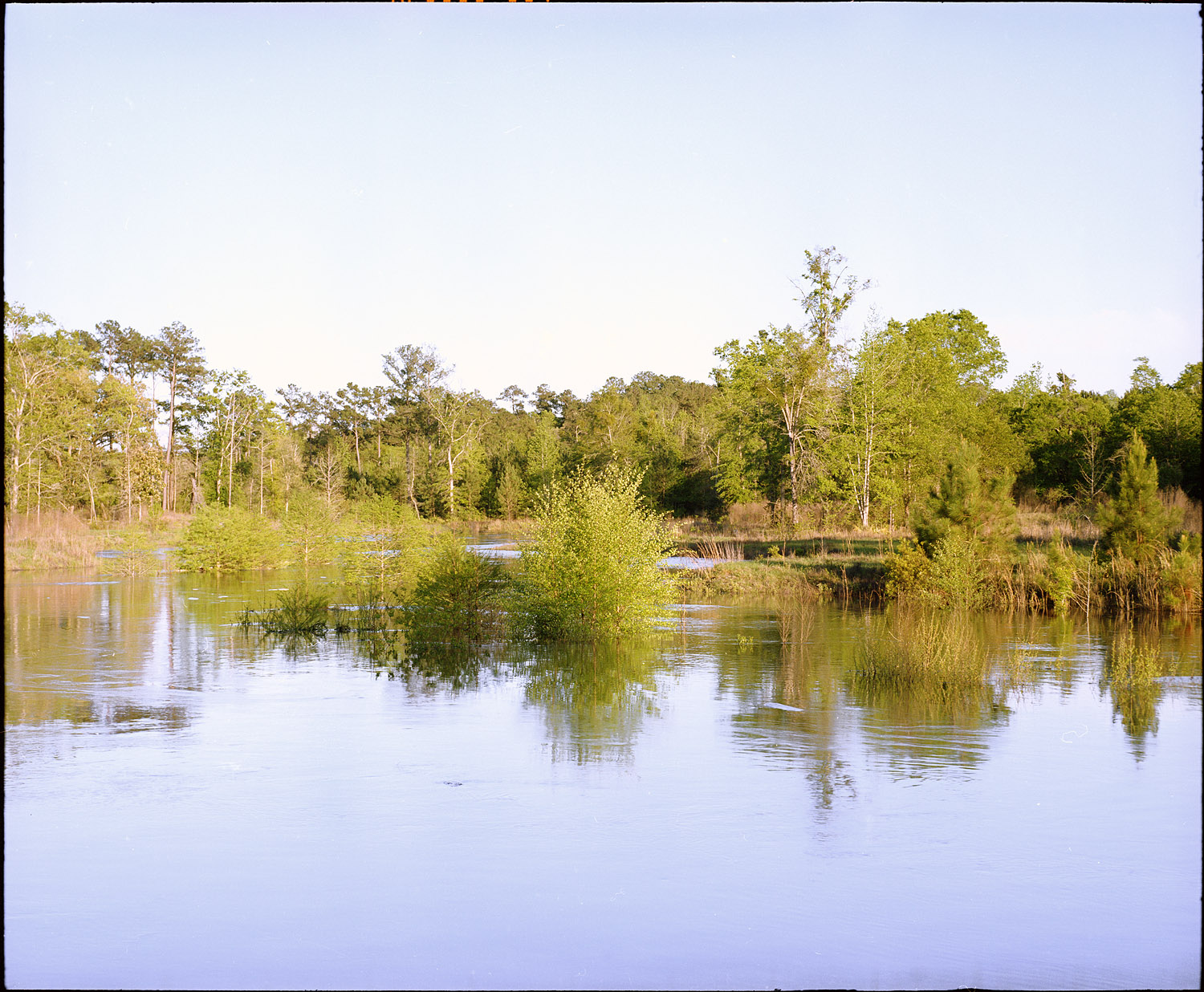
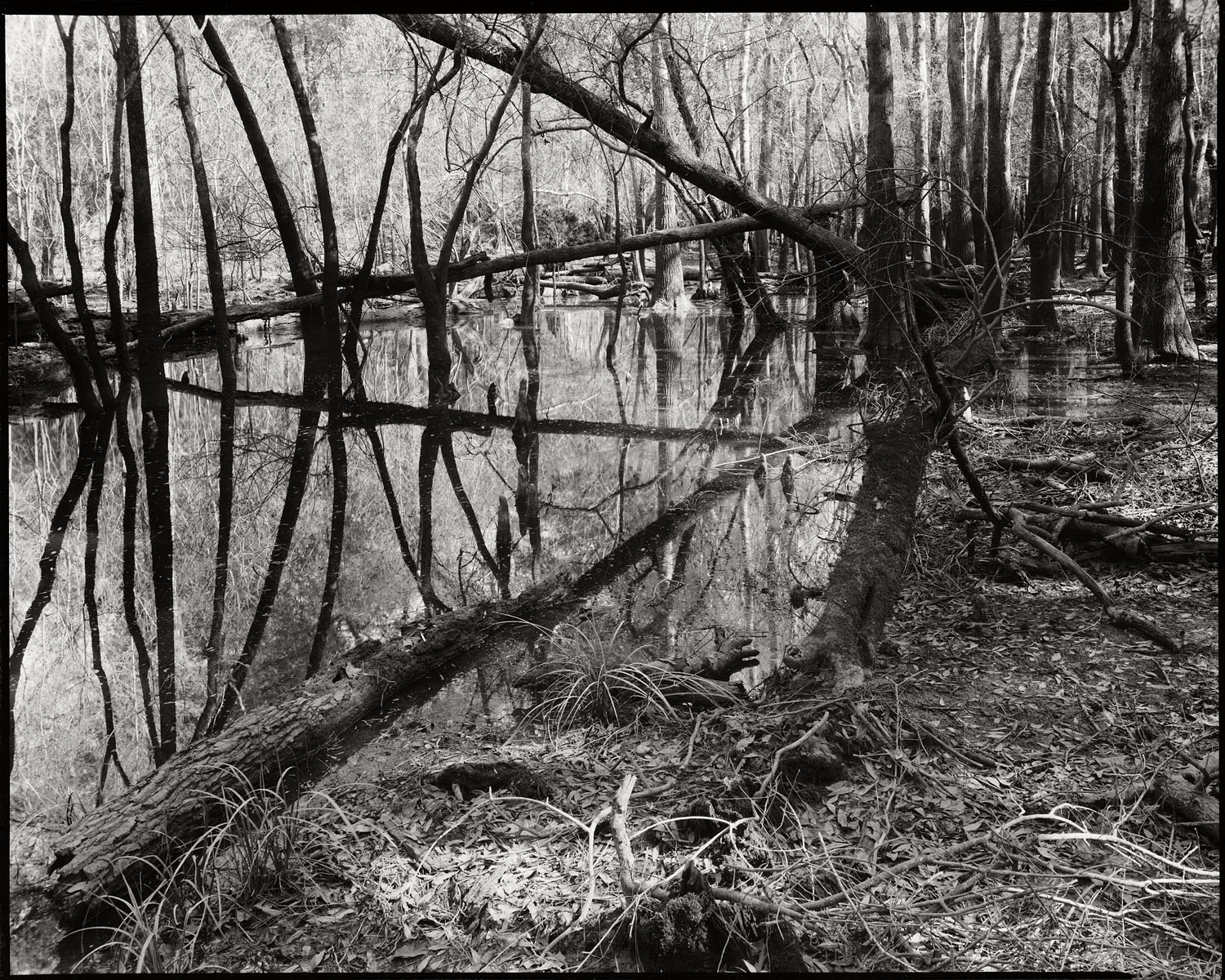
Now for the results of the past couple of weeks! Firstly, I went back to Banks Lake for some exploring before the water got back to normal depth:
Here's one more from Banks Lake in color:
All of the above were with the 38mm XL on the custom camera.
Now I also took the little Graphic with me to a family Easter get-together, and shot some handheld photos with the 80mm Xenotar:
We found a snake in the woods too:
Last week I went exploring in a new place, another access point to the Withlacoochee, but this area was completely flooded due to rain. I took several photos with both the custom and normal cameras, using the 38mm XL, 80mm Xenotar, and 10.5cm APO Lanthar:
I made another trip to Banks Lake, but this time explored deep into the woods along the swampy banks. I wanted to try a few other lenses out that I hadn't used yet, so I brought along my 65mm Super Angulon, 103mm Graflex Trioptar, and 135mm Rodenstock Trinar, along with a 6x9 back. This is the first time I've shot 6x9 on the Century:
I took a portrait of my friend Dominick who went shooting with me, and a random guy chilling on the dock:
And one more of the old Rolleicord, just for fun:
That's it for those photos. These last photos with the 103mm Trioptar have quite a nice look to them, especially in the depth of field. I really like this lens, and it only cost $25. I actually bought it just to get the 2x3 Century lens board that it was attached to!
Overall I am really happy with these results and the camera is a great addition to my arsenal. While it doesn't really replace my 4x5, it can be liberating to shoot with roll film and have the ability to bracket a little and shoot a lot more exposures.
That about wraps it up for my second look at the Century Graphic. I might shoot it some more tomorrow, we'll see!
Showing posts with label Reviews. Show all posts
Friday, April 8, 2016
Monday, March 28, 2016
Wehman "Ultralight" 8x10 Field Camera
These days it seems like there is no shortage of new companies building 8x10 and other size field cameras, often with space-age materials and impressive specs (and impressive price). I bought my first 8x10 camera, a Gundlach built in 1899, about 4 years ago. It was cheap and came with a cool lens, and I shot nothing but x-ray film with it for a long time. Later on I found a Wista 8x10, made by Tachihara, that was a bit more versatile and easier to use - but it was still really heavy and the thin paper bellows made me worried when hiking, as an errant tree branch could puncture it and ruin the camera.
I started thinking about upgrading my camera but the expensive new production models, even used, were just not the right fit for me. They were also for the most part still quite heavy. So when I saw a Wehman 8x10 "ultralight" advertised, I was intrigued. Looking up the specs, I discovered it was about 7 pounds, plus another pound could be shaved off by removing the top "clamshell," reducing the total extension (which I rarely would use). My mind was made up. I bought it.
In-hand, I was really amazed by the simple and elegant design and the great look of the camera. In the field, it was the perfect blend of simple usage and versatility. I have read in several places that Wehman only made two of these "ultralight" models but I can not verify that. Either way, I think this is the last 8x10 camera I'll ever need.
Last weekend I took it for its first large hike (about 3 miles). It was easy to carry and didn't weigh me down, and being so light I could also use a slightly less heavy tripod without worry. I hardly broke a sweat carrying the load, with 4 lenses in my bag and 12 sheets of film in 6 holders.
I hiked at Langdale Park, which was closed for "repair" earlier this year - but a local conservation group was allowed access to paddle down the river and take out at Langdale Park, so I tagged along.
Here are the photos from that day. First are a few on Delta 100, developed in FX-39, using either my 210mm f/9 Graphic Kowa, 300mm f/9 Nikkor-M, 25cm f/4.7 Fujinar, or 90mm f/5.6 Schneider XL (cropped slightly):
I also tried out two photos on Efke IR820 AURA film. I have a big box of this I've never used. Here are those photos (duplicates of the above, as I wasn't sure the Wehman bellows were IR light-tight...luckily it is!):

I started thinking about upgrading my camera but the expensive new production models, even used, were just not the right fit for me. They were also for the most part still quite heavy. So when I saw a Wehman 8x10 "ultralight" advertised, I was intrigued. Looking up the specs, I discovered it was about 7 pounds, plus another pound could be shaved off by removing the top "clamshell," reducing the total extension (which I rarely would use). My mind was made up. I bought it.
In-hand, I was really amazed by the simple and elegant design and the great look of the camera. In the field, it was the perfect blend of simple usage and versatility. I have read in several places that Wehman only made two of these "ultralight" models but I can not verify that. Either way, I think this is the last 8x10 camera I'll ever need.
Last weekend I took it for its first large hike (about 3 miles). It was easy to carry and didn't weigh me down, and being so light I could also use a slightly less heavy tripod without worry. I hardly broke a sweat carrying the load, with 4 lenses in my bag and 12 sheets of film in 6 holders.
I hiked at Langdale Park, which was closed for "repair" earlier this year - but a local conservation group was allowed access to paddle down the river and take out at Langdale Park, so I tagged along.
Here are the photos from that day. First are a few on Delta 100, developed in FX-39, using either my 210mm f/9 Graphic Kowa, 300mm f/9 Nikkor-M, 25cm f/4.7 Fujinar, or 90mm f/5.6 Schneider XL (cropped slightly):
I also tried out two photos on Efke IR820 AURA film. I have a big box of this I've never used. Here are those photos (duplicates of the above, as I wasn't sure the Wehman bellows were IR light-tight...luckily it is!):
Finally, I had one more sheet of Delta 100, so I took this photo of the WWALS group with that:

Now right before I took this last image, I had one bad thing happen - I slipped and fell pretty bad on some mud. The Wehman 8x10 took a dive and hit the ground hard too. Everything seemed okay, but then I discovered the nylon focus track had a few teeth go missing! I was dismayed, but I sent Mr. Wehman an email to see if he had parts. Amazingly, he responded later that day and offered to send a free replacement! What a great service and awesome guy! I just received the part today and installed it in just a few moments, and it's back to like-new condition (after I cleaned up the mud...).
I love this camera and can't wait to shoot it more!
Oh! One more thing. My friend Julie took this photo of me with the camera before I left:
Friday, September 4, 2015
Testing a Bausch & Lomb 6" f/6.3 Metrogon on 8x10
The 6" (~153mm) Metrogon is one of those lenses that often comes up for discussion as it has a bit of a "mythos" about it. It was apparently used by the US Military for aerial photography, and is based off of (or identical to) the "Topogon" lens designed by Carl Zeiss (see my Nikkor 2.5cm f/4 review for more information on that design).
I thought a large-format topogon would be interesting, considering my small-format equivalent, so when I found one on eBay with a built-in shutter and on a lensboard made for my Wista 8x10, I splurged and bought it (though it was really pretty cheap).
The lens is quite a big and heavy beast and is quite striking with its extremely curved fishbowl-esque front and back elements:
I had some film to kill so I went out to try it on 8x10. I was quite pleased with how well the lens performed:
That last one was made with a 100mm Linhof slip-on filter made for my 75mm Biogon, which perfectly slips into the front element "hood" built into the lens. It made the tonality of the sky and trees much more as I envisioned it.
Overall I like the lens and it definitely works well as an in-between focal length longer than my 120mm Nikkor and shorter than my 210mm Kowa.
So how good is it? Well, the basic scans I did on these sheets were 180 megapixels or so total - 1500 DPI for the 8x10 sheet. Here is a crop of the first scan at 100% resolution, which would be equivalent to about a 12-foot print at typical monitor resolutions (96 DPI):
Not bad! Of course this isn't really anything special for an 8x10 negative, but still. Oh, just as an aside, all of these were taken at f/32.
I thought a large-format topogon would be interesting, considering my small-format equivalent, so when I found one on eBay with a built-in shutter and on a lensboard made for my Wista 8x10, I splurged and bought it (though it was really pretty cheap).
The lens is quite a big and heavy beast and is quite striking with its extremely curved fishbowl-esque front and back elements:
I had some film to kill so I went out to try it on 8x10. I was quite pleased with how well the lens performed:
That last one was made with a 100mm Linhof slip-on filter made for my 75mm Biogon, which perfectly slips into the front element "hood" built into the lens. It made the tonality of the sky and trees much more as I envisioned it.
Overall I like the lens and it definitely works well as an in-between focal length longer than my 120mm Nikkor and shorter than my 210mm Kowa.
So how good is it? Well, the basic scans I did on these sheets were 180 megapixels or so total - 1500 DPI for the 8x10 sheet. Here is a crop of the first scan at 100% resolution, which would be equivalent to about a 12-foot print at typical monitor resolutions (96 DPI):
Not bad! Of course this isn't really anything special for an 8x10 negative, but still. Oh, just as an aside, all of these were taken at f/32.
Subscribe to:
Posts (Atom)